








Laminar Air Flow (LAF) Units: Vertical vs Horizontal, Hood & Mobile
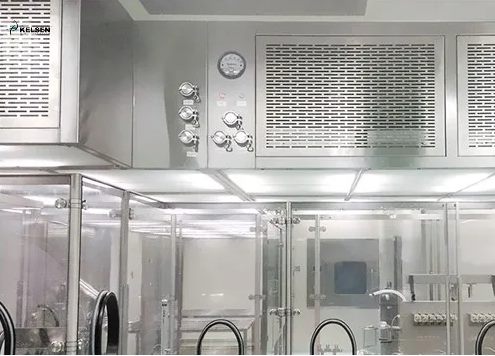
A laminar air flow (LAF) unit — also called a laminar flow hood, LAF cabinet or unidirectional airflow unit — delivers a smooth, HEPA-filtered stream of air across a work zone, holding Grade A / ISO 5 right where an exposed product needs it. This guide covers what a LAF unit does, vertical versus horizontal flow, the one safety rule people get wrong, the main types (hood, mobile trolley, filling-line canopy, pass box), and how a LAF is specified and qualified.
What is a laminar air flow unit?
A LAF unit draws room air through a pre-filter and a final HEPA filter, then delivers it as a unidirectional (“laminar”) stream — parallel streamlines at a uniform velocity — that sweeps particles away from the work zone in one direction. Because the airflow is clean and unidirectional, the unit maintains Grade A / ISO 5 conditions locally, so exposed product, components or containers stay protected even when the surrounding room is only Grade C/D. Airflow velocity is typically around 0.45 m/s (EU GMP Annex 1 guides roughly 0.36–0.54 m/s at the working position). It is the simplest, most economical way to create a clean-air island for a defined task.
Vertical vs horizontal laminar flow
The two configurations differ in which way the clean air travels:
| Vertical LAF | Horizontal LAF | |
|---|---|---|
| HEPA position | Top / ceiling of the unit | Back wall of the unit |
| Airflow | Downward over the work surface | Horizontal, toward the opening |
| Strengths | Mimics cleanroom downflow; tall items don’t shadow the whole zone; less air blown at the operator | Excellent front-to-back sweep across flat work; roomy headspace |
| Watch-outs | Tall items can create downstream turbulence below them | Items placed behind others are shadowed; air flows over product then at the operator |
| Typical use | Filling zones, dispensing, mobile production LAF | Bench-top assembly, inspection, component prep |
The one rule people get wrong: LAF protects the product, not you
A laminar flow unit blows clean air over the product and toward the operator. That protects the product — but it means a LAF must never be used for hazardous, potent or infectious material, because it would blow that material straight at the person. For a potent compound or a live organism you need a containment device that pulls air inward: a biosafety cabinet, or a negative-pressure containment isolator. LAF = product protection; containment = operator protection. Getting this backwards is a genuine safety hazard.
Types of LAF unit
- Laminar flow hood / cabinet — a bench or freestanding laminar flow hood giving Grade A over open handling and inspection.
- Filling-line canopy — a filling-line laminar flow unit hung over the critical filling zone of a line.
- Mobile / height-adjustable trolley — a wheeled height-adjustable laminar trolley that brings a Grade A island to wherever the task is — the format most vaccine and pharma production teams ask for, often as a 6 ft mobile vertical LAF.
- Laminar flow pass box — a dynamic laminar flow pass box holding Grade B/A during material transfer.
Specification & qualification
- HEPA — final filter to EN 1822 H14 (≥99.995% at MPPS), each filter with a serial number and manufacturer certificate, installed bypass-leak-free.
- Velocity — uniform unidirectional flow, typically ~0.45 m/s, within the qualified range; no turbulence or dead zones (per EU GMP Annex 1).
- MOC — SS304 external, SS316L for critical surfaces where applicable; smooth, cleanable, crevice-free welds; corrosion-resistant locking castors on mobile units.
- Instruments — air-velocity indicator, filter differential-pressure gauge, hour meter; adequate lighting.
- Qualification (IQ/OQ/PQ) — HEPA integrity (DOP/PAO), airflow velocity/uniformity, airflow visualization (smoke study) and particle count per ISO 14644-1/-3. For the ISO grades, see ISO 14644 Classification.
FAQ
LAF unit or biosafety cabinet?
A LAF protects the product only. If the material is infectious, cytotoxic or potent, use a biosafety cabinet or a negative-pressure containment isolator instead — never a LAF.
Vertical or horizontal?
Vertical suits filling/dispensing and mobile production carts and keeps air off the operator; horizontal suits flat bench work like assembly and inspection. Tall items favour vertical.
What cleanliness grade does a LAF give?
Grade A / ISO 5 locally over the work zone, typically inside a Grade C/D background room.
Related Products
Laminar Flow HoodGrade A laminar airflow over open processing and inspection.Air Handling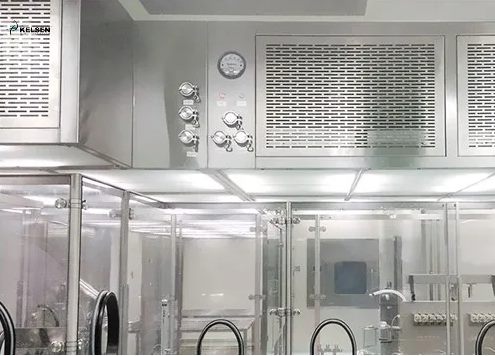 Filling Line Laminar Flow UnitGrade A laminar canopy over the filling zone.Air Handling
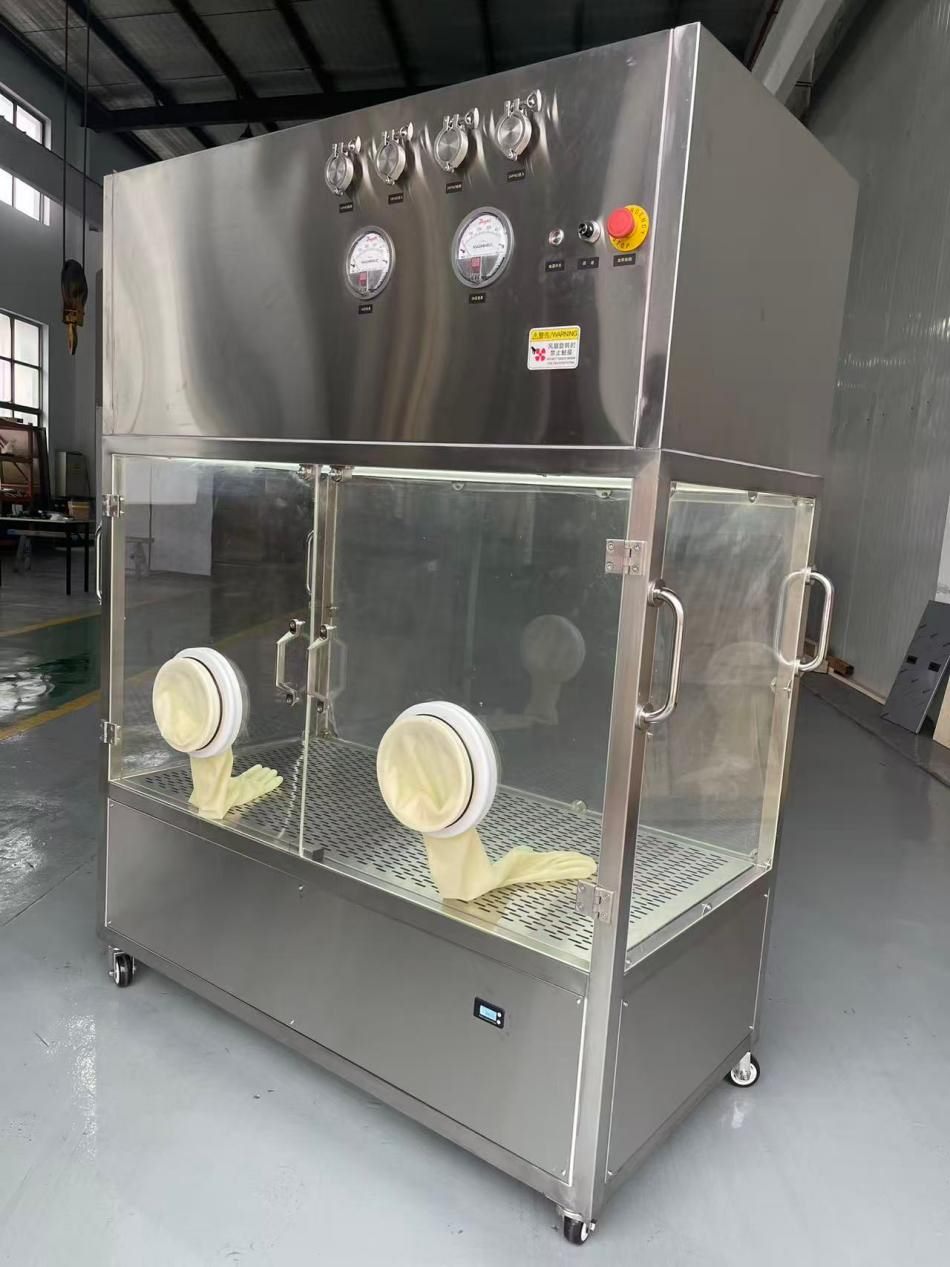 Height-Adjustable Laminar TrolleyLaminar trolley with adjustable working height for ergonomic handling.Air Handling
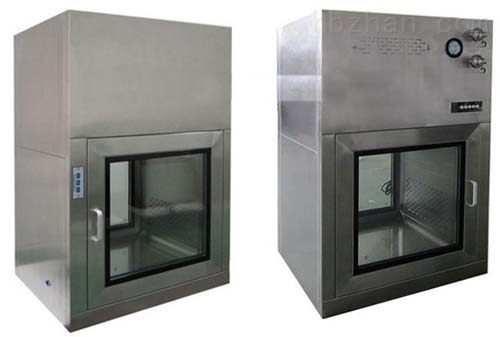 Laminar Flow Pass BoxDynamic hatch holding Grade B with H14 HEPA laminar airflow.Transfer & Containment
Sourcing a laminar air flow unit?
Tell us your working width, vertical or horizontal, fixed or mobile, and target grade — our engineers will configure a HEPA H14 LAF unit with the certificates and qualification support your project needs.